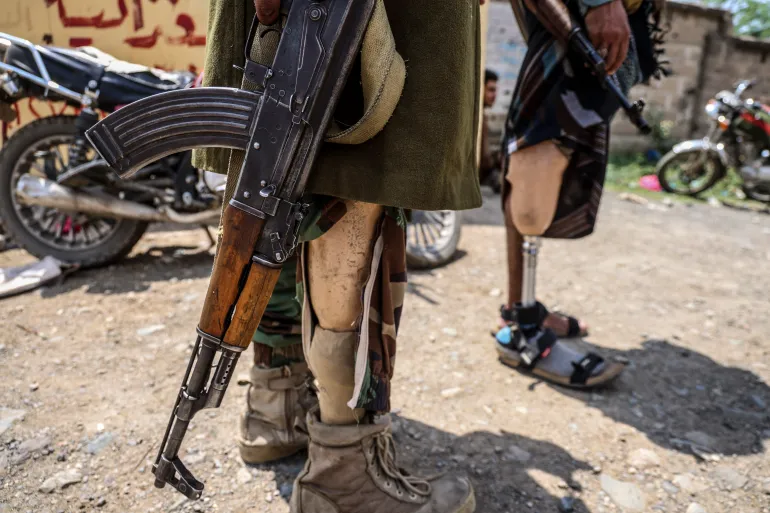
Yemeni government forces launch an offensive toward Sanaa as fighting with the Houthis intensifies around Bab al-Mandeb, Taiz and the Red Sea.
Yemeni Government Forces Push Toward Sanaa as Houthi War Escalates
Yemeni government forces have launched a major offensive aimed at reversing recent Houthi gains and eventually reclaiming the capital, Sanaa. The campaign marks a significant escalation in Yemen’s long-running conflict and comes as government forces seek to regain strategically important territory along the Red Sea coast.
The offensive was announced by Rashad al-Alimi, head of Yemen’s Presidential Leadership Council, who called for the recovery of territories controlled by the Houthis. Government-aligned forces have since reported advances near the Bab al-Mandeb Strait, one of the world’s most important maritime routes.
According to government sources, forces moving north along the Red Sea coast have retaken the town of Dhubab and the port city of Mocha. They have also announced plans for a broader military operation targeting Houthi-controlled areas, including Sanaa.
The government is simultaneously trying to stop further Houthi advances around Taiz, a strategically important city in southwestern Yemen. Control of Taiz and nearby coastal areas could have major military and political implications for both sides.
Yemen conflict enters a new phase
The Houthis, an Iran-aligned movement, have controlled Sanaa since September 2014. The group later expanded its influence across large parts of northern and western Yemen, becoming the dominant military and political force in much of the country.
Yemen experienced several years of relative calm after intense fighting, but that stability began to break down again in July. Fighting intensified further in September when Houthi forces launched a major offensive along the Red Sea coast.
The Houthis made significant territorial gains during that campaign, including capturing areas around Mocha and the Bab al-Mandeb region. The latest government offensive appears to be an attempt to reverse those gains before they become permanently established.
However, defeating the Houthis will be difficult.
Yemen’s internationally recognised government has a sizeable collection of military forces, but those forces remain divided among different political and regional factions. They are also spread across multiple battlefronts and often rely on equipment dating from before the current war.
Analysts say government forces may be capable of defending their positions, but pushing the Houthis out of their heavily fortified mountain areas will be a much more complicated task.
Why capturing Sanaa will be difficult
Sanaa remains the Houthis’ most important political and military stronghold. Any attempt to capture the capital would require a major military campaign and could lead to some of the heaviest fighting Yemen has experienced in years.
Government forces also face the challenge of fighting on several fronts at the same time. While troops advance along the Red Sea coast, Houthi forces continue to apply pressure around Taiz and Marib.
The Houthis have demonstrated an ability to operate across multiple fronts simultaneously. Government forces, by comparison, have often struggled to coordinate their military operations because of divisions within the wider anti-Houthi coalition.
The situation in Taiz is particularly important. Government forces have generally performed better defensively in the area, but Houthi units have continued attempting to expand their positions.
The government is also seeking greater control over parts of Taiz governorate, including the al-Shamayatayn and al-Waziya districts. Security forces have reportedly launched operations in villages and rural areas where Houthi fighters are believed to have established a presence.
Saudi Arabia’s role
The Yemeni government has long received support from Saudi Arabia, which considers the Houthi movement a major security threat along its southern border.
Any large-scale government offensive could therefore have wider regional consequences. Saudi Arabia is likely to focus on preventing renewed Houthi attacks and securing its border while supporting efforts to strengthen Yemen’s recognised government.
At the same time, the anti-Houthi camp remains politically divided. Different military and political groups have their own interests, making it difficult to create a unified strategy for defeating the Houthis.
This fragmentation could become one of the biggest obstacles to a successful campaign for Sanaa.
Could Yemen face another prolonged war?
The latest fighting suggests Yemen may be entering a more dangerous period. Although some leaders on both sides may support a broader military confrontation, a complete military victory for either camp remains uncertain.
A negotiated settlement could ultimately be more realistic than the complete destruction of one side.
Such an agreement could leave the Houthis with substantial influence in northern Yemen while providing Saudi Arabia with stronger security guarantees. Yemen’s competing political and military factions could also be pushed toward some form of power-sharing arrangement.
However, reaching a political settlement may prove difficult if the fighting continues to intensify.
For now, the Yemeni government is attempting to set the pace of the conflict rather than allowing the Houthis to determine where and when battles take place. Its latest advances along the Red Sea coast are intended to demonstrate that the government is serious about reversing Houthi territorial gains.
Whether those advances can eventually translate into a successful campaign for Sanaa remains uncertain.
The coming weeks could therefore be critical for the future of the Yemen conflict. If government forces manage to maintain their momentum and coordinate their various military factions, they could put greater pressure on the Houthis. But if internal divisions remain unresolved, the offensive could instead develop into another prolonged phase of fighting without producing a decisive victory.