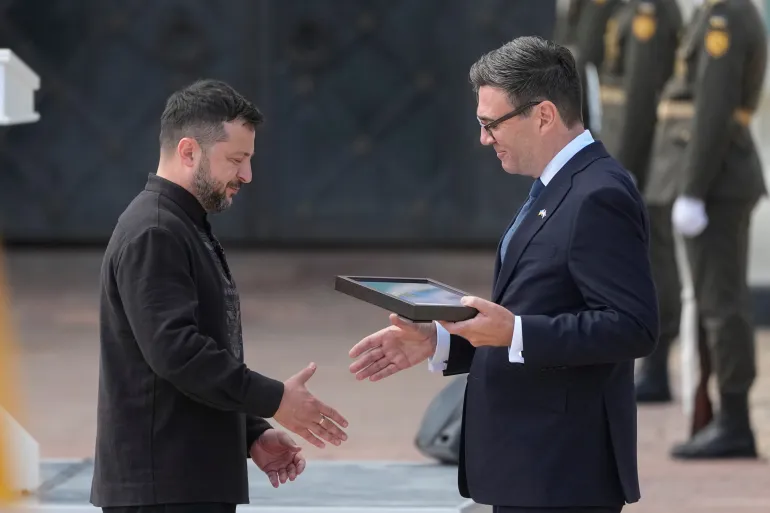
The UK will share missile technology with Ukraine to support domestic Storm Shadow production, strengthening its long-range defence capabilities.
UK to Help Ukraine Build Storm Shadow Missiles: Why It Matters
The United Kingdom is preparing to share sensitive missile-production technology with Ukraine, allowing Kyiv to develop and manufacture its own version of the Storm Shadow long-range cruise missile. The move could significantly strengthen Ukraine’s ability to produce advanced weapons domestically and reduce its dependence on foreign missile supplies.
The decision comes as European countries seek to increase military support for Ukraine amid continued Russian attacks. It also highlights a growing effort to strengthen Ukraine’s domestic defence industry and give the country greater control over its long-range strike capabilities.
Why the Storm Shadow Missile Matters
Storm Shadow, known as SCALP in France, is a sophisticated long-range cruise missile developed through British and French defence cooperation. It has a range of roughly 560km, allowing it to strike targets far beyond the immediate battlefield.
Ukraine has already developed long-range drones and several missile systems of its own. However, Storm Shadow provides a different capability because it is designed to attack heavily protected and strategically important targets.
The missile combines long-range navigation technology with precision guidance, allowing it to operate during both day and night and in difficult weather conditions. Its ability to reach defended targets makes it particularly valuable for attacks against military infrastructure, command facilities and other strategic locations.
Storm Shadow missiles are considerably more expensive than many of the drones Ukraine produces in large numbers. As a result, they are generally reserved for carefully selected targets where precision and penetration of strong defences are especially important.
Ukraine’s Growing Missile Industry
Ukraine has rapidly expanded its domestic defence production since Russia launched its full-scale invasion. The country now manufactures large numbers of drones, interceptors and other weapons while continuing to develop increasingly sophisticated missile technology.
Among Ukraine’s domestically developed systems are the Neptune and Flamingo cruise missiles. Ukrainian engineers have also been working on longer-range missile and ballistic systems.
Producing a weapon as complex as Storm Shadow, however, presents a much greater challenge than manufacturing relatively inexpensive drones.
The missile incorporates decades of research, advanced guidance systems and highly specialised components. Access to production knowledge could therefore save Ukraine years of development work and provide its defence industry with valuable manufacturing expertise.
Technology Transfer Could Increase Production
The biggest advantage of domestic Storm Shadow production may not simply be the missile itself. It could be Ukraine’s ability to manufacture larger quantities.
Ukraine has often had to carefully select targets because supplies of advanced Western weapons are limited. Increasing domestic production could give its military a more reliable supply of long-range precision weapons.
Higher production could also reduce Ukraine’s dependence on foreign deliveries and allow it to respond more quickly to changing battlefield conditions.
For Ukraine, the ability to manufacture sophisticated missiles domestically would represent another major step toward building an independent defence industry capable of supporting a prolonged conflict.
How Quickly Could Ukraine Produce Storm Shadow Missiles?
Building a production line for a complex cruise missile will not happen immediately. Britain and France have indicated that they want to help establish production capacity in Ukraine, potentially within the year.
However, creating a new missile manufacturing programme could take considerably longer. A production system of this complexity requires specialised machinery, trained engineers, testing facilities and a dependable supply chain.
Some components may also depend on international suppliers. Storm Shadow contains sensitive technologies developed through cooperation between several countries, meaning certain parts of the manufacturing process could require additional approvals.
Ukraine would therefore need to build not only the missile assembly process but also a reliable network for producing and sourcing critical components.
Russia Could Target Production Facilities
Security will be one of the biggest challenges facing Ukrainian missile production.
Factories capable of manufacturing long-range missiles would likely become important targets for Russian missile and drone attacks. Ukraine would need to protect these facilities while ensuring production continues even under sustained military pressure.
One possible approach would be to distribute manufacturing across multiple locations rather than concentrating the entire production process in one facility. Protecting key equipment, maintaining supplies and securing transport routes would also be essential.
A Major Shift in Defence Cooperation
The transfer of classified missile-production knowledge could establish an important precedent for future military cooperation.
Instead of simply supplying finished weapons, European countries would be helping Ukraine develop the industrial capacity to manufacture advanced systems independently.
This could strengthen Ukraine’s long-term military resilience and reduce pressure on foreign weapons stockpiles.
For Europe, the initiative also reflects a broader effort to increase support for Ukraine and strengthen its ability to defend itself.
What It Means for Ukraine
If Ukraine successfully establishes domestic Storm Shadow production, the impact could extend beyond the battlefield.
It would demonstrate that Ukraine can manufacture highly advanced Western-designed weapons under wartime conditions. It could also accelerate the development of Ukraine’s broader missile industry and create new opportunities for cooperation with European defence manufacturers.
The project will face major technical, financial and security obstacles. Nevertheless, access to advanced missile-production technology could become a significant milestone in Ukraine’s effort to build a stronger and more self-reliant defence industry.