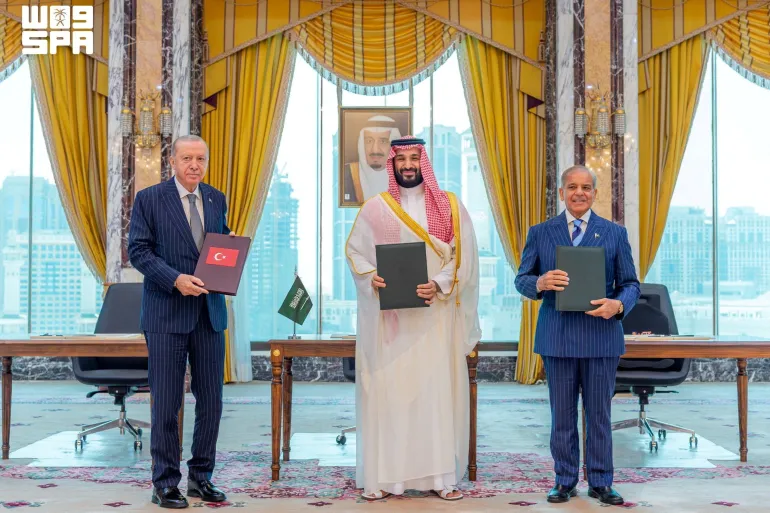
Saudi Arabia, Pakistan and Turkiye sign a defence pact as Iran tensions rise, reshaping Gulf security, deterrence and regional power dynamics.
Saudi-Pakistan-Turkiye Pact: A New Regional Shield or Strategic Signal?
Mecca, Saudi Arabia — Saudi Arabia, Pakistan and Turkiye have signed a landmark joint defence agreement that could reshape security calculations across the Middle East and South Asia.
The Makkah Joint Defence Agreement declares that an armed attack against any one of the three countries would be treated as an attack against all three. Although the agreement does not identify a specific enemy, its timing has immediately raised questions about Iran, regional armed groups and the changing balance of power in the Middle East.
The pact was signed in Mecca by Saudi Crown Prince Mohammed bin Salman, Turkish President Recep Tayyip Erdogan and Pakistani Prime Minister Shehbaz Sharif. The three leaders presented the agreement as a framework for peace, stability and collective security rather than an alliance directed against another country.
However, analysts believe its strategic significance goes beyond the language of the agreement.
A growing regional security partnership
The new defence pact builds on the Saudi-Pakistan security agreement signed in 2025. Adding Turkiye gives the partnership a broader military and industrial dimension.
The three countries have already maintained defence cooperation for several years, including discussions involving military technology, training and defence industries. The latest agreement formalises a much deeper strategic relationship at a time when regional tensions remain high.
Security analysts say the pact may initially function more as a deterrence mechanism than as a fully integrated military alliance.
Its greatest value could be the uncertainty it creates for potential adversaries. Instead of establishing detailed military obligations similar to traditional Western alliances, the agreement sends a message that an attack on one member could trigger a coordinated response from the others.
Iran remains a central concern
Iran is not mentioned in the agreement, but its regional influence is difficult to ignore.
The Middle East has experienced growing tensions involving Iran and a network of armed groups, including Hezbollah, the Houthis and Iraqi Shia militias. Saudi Arabia has also faced security threats linked to attacks on energy infrastructure and shipping routes.
The latest defence agreement therefore gives Saudi Arabia another layer of regional deterrence while allowing the three governments to avoid openly declaring Iran an adversary.
That ambiguity could be intentional.
For Saudi Arabia, the agreement offers an opportunity to strengthen its security capabilities while reducing dependence on a single external security partner. Riyadh has increasingly sought to develop domestic defence industries and build stronger relationships with regional powers.
What Saudi Arabia, Pakistan and Turkiye bring
Each country contributes something different to the partnership.
Saudi Arabia brings significant financial resources, strategic geography and growing investment in defence technology.
Pakistan provides a large and experienced military, geographic access to South Asia and the strategic significance of being a nuclear-armed state. However, analysts caution against viewing Pakistan’s nuclear capability as a formal part of the agreement.
Turkiye brings one of the region’s fastest-growing defence industries, advanced military technology and extensive experience in developing drones and other defence systems.
For Riyadh, cooperation with Turkiye could be particularly valuable as Saudi Arabia attempts to expand its own defence manufacturing capabilities.
For Ankara, meanwhile, the pact provides greater strategic reach into both the Gulf and South Asia while creating another layer of security cooperation beyond its existing alliances.
Pakistan’s diplomatic balancing act
The agreement could create a difficult diplomatic challenge for Pakistan.
Islamabad has attempted to maintain communication with both Saudi Arabia and Iran while presenting itself as a potential mediator during regional crises. Becoming part of a formal collective-defence arrangement could make that role more complicated.
At the same time, Pakistan has strong economic and financial ties with Saudi Arabia. Saudi support has played an important role in Pakistan’s external finances, giving the relationship significant economic as well as security importance.
Some analysts believe Pakistan’s inclusion could actually provide the agreement with diplomatic protection because Islamabad can continue engaging Tehran while remaining part of the new security framework.
How might Iran respond?
Iran’s initial reaction has been critical but relatively restrained. Tehran is likely to examine the agreement carefully before deciding how aggressively to respond.
The collective-defence clause could be particularly important because it changes the strategic meaning of each country’s individual relationship with Iran.
Pakistan is likely to receive special attention because it shares a border with Iran and has maintained a role in regional diplomacy. Turkiye also has strong incentives to prevent the agreement from triggering a direct confrontation with Tehran.
A shield rather than a traditional military alliance?
For now, the Saudi-Pakistan-Turkiye defence pact appears to be more of a strategic signal than a fully operational military alliance.
Its long-term importance will depend on whether the three countries develop joint military planning, intelligence cooperation, defence production and coordinated responses to future crises.
The agreement does not name Iran as a threat, but it clearly reflects a region where governments are reassessing their security strategies.
If the partnership expands to include countries such as Qatar or Kuwait, it could become an important new pillar of Middle East security, potentially creating a broader regional network focused on deterrence, defence cooperation and strategic stability.