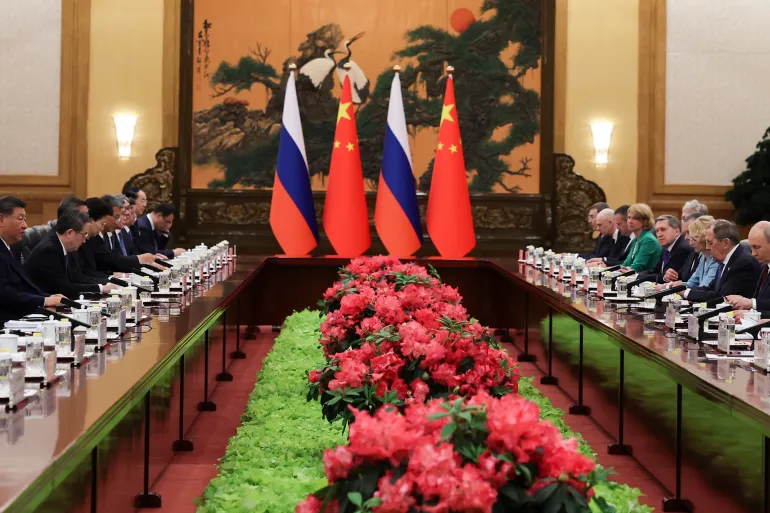
Russia and China are advancing plans for the Power of Siberia 2 gas pipeline, a major energy project designed to boost Russian exports and strengthen China’s energy security.
What Is the Power of Siberia 2 Pipeline and Why Does It Matter for Russia and China?
Russia and China are moving closer to advancing one of the world’s biggest energy infrastructure projects — the proposed Power of Siberia 2 (POS-2) gas pipeline. The massive project is expected to strengthen economic ties between the two countries while reshaping global energy markets in the years ahead.
The planned pipeline was one of the major topics discussed during the recent summit between Russian President Vladimir Putin and Chinese President Xi Jinping. Although final agreements have not yet been completed, both sides confirmed that they have reached a broad understanding regarding the route and construction plans.
The Power of Siberia 2 pipeline would transport natural gas from western Siberia in Russia through Mongolia and into China. Stretching approximately 2,600 kilometres (1,616 miles), the pipeline is expected to carry up to 50 billion cubic metres of gas annually, making it one of the largest energy pipelines in the world.
The scale of the project is comparable to the former Nord Stream 1 pipeline that once supplied large volumes of Russian gas to Europe before relations deteriorated following the Ukraine war. For Russia, the new pipeline represents a major opportunity to replace lost European energy revenues. For China, it offers a potentially safer and more stable source of natural gas imports.
Russia’s energy exports to Europe sharply declined after many European countries reduced dependence on Russian gas following Moscow’s full-scale invasion of Ukraine in 2022. Since then, Russia has increasingly shifted its economic focus toward Asia, especially China, which remains one of the world’s largest energy consumers.
The Power of Siberia 2 project is seen as a central part of Russia’s long-term strategy to redirect gas exports away from Europe and toward Asian markets. Russian energy giant Gazprom is expected to play a leading role in constructing and operating the pipeline.
Russia hopes the project will generate billions of dollars in future energy revenue while supporting its steel, construction, and industrial sectors. However, experts say Moscow is negotiating from a weaker position than before because it urgently needs new buyers for gas once destined for Europe.
China, meanwhile, has taken a more cautious approach. Beijing understands Russia’s growing need for export markets and is reportedly pushing for lower gas prices during negotiations. Analysts believe pricing remains one of the biggest unresolved issues delaying a final agreement.
For China, the pipeline carries important strategic advantages beyond simple energy supply. Currently, much of China’s imported liquefied natural gas (LNG) travels by sea through sensitive maritime chokepoints such as the Strait of Hormuz and the Strait of Malacca. These routes are vulnerable to geopolitical tensions, shipping disruptions, and military conflicts.
Pipeline gas from Russia would provide China with a more secure land-based energy supply that is less exposed to global shipping risks and price volatility. It would also help Beijing diversify energy imports while strengthening long-term economic cooperation with Moscow.
The project could also benefit Mongolia, which lies between Russia and China. Mongolia is expected to earn significant transit fees from the pipeline while improving its regional economic importance.
Despite growing political support, the project still faces major challenges. Building such a large pipeline across vast and difficult terrain requires years of construction, enormous investment, and extensive international coordination. Experts estimate it could take close to a decade from the start of construction before the pipeline reaches full operating capacity.
Another major concern involves long-term dependency. Analysts say Russia risks becoming heavily dependent on China as its primary gas customer, giving Beijing significant leverage over pricing and future negotiations. China, on the other hand, may worry about relying too heavily on Russian energy during an era of global political uncertainty.
The pipeline also reflects broader geopolitical changes taking place around the world. Both Russia and China increasingly seek to reduce dependence on Western-led financial and energy systems while strengthening strategic cooperation between their economies.
Energy analysts believe the Power of Siberia 2 pipeline could reshape global natural gas markets in the coming decades. By increasing pipeline gas supplies to China, the project may reduce China’s future demand for imported LNG cargoes from other regions, potentially lowering global LNG prices over time.
The project may also accelerate the transition toward a more regionalized global energy system where countries rely increasingly on long-term political and strategic partnerships instead of fully globalized energy trade networks.
Even so, experts caution that Power of Siberia 2 will not fully replace the enormous revenues Russia once earned from European gas exports. Instead, the project is viewed as part of Russia’s broader pivot toward Asia as global energy alliances continue to evolve.
As negotiations continue, the world will closely watch whether Moscow and Beijing can finalize one of the most ambitious energy partnerships of the modern era. More