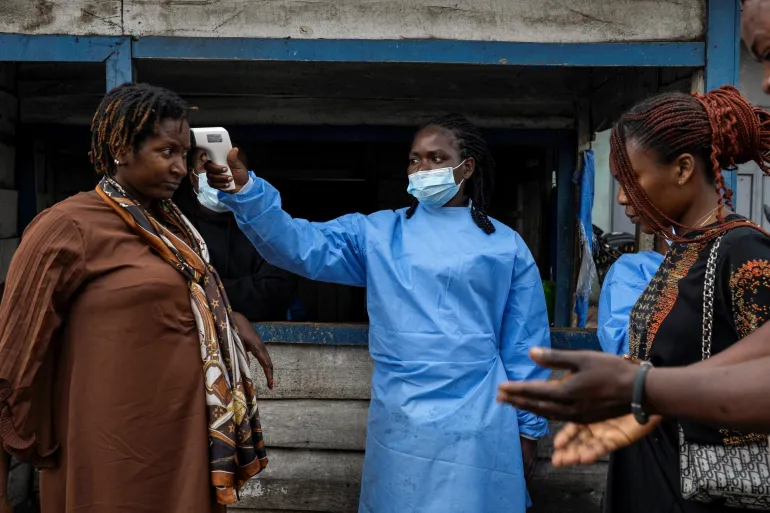
The new Bundibugyo strain of Ebola is spreading across Central Africa with no approved vaccine yet. Here’s what experts say about vaccine development and the outbreak response.
Ebola Outbreak Raises Global Alarm as Scientists Race to Develop Vaccine for New Bundibugyo Strain
A new outbreak of the deadly Ebola virus is causing growing concern across Central Africa as health experts warn that the disease is spreading rapidly with no approved vaccine currently available for the newly identified Bundibugyo strain.
The latest outbreak has affected the Democratic Republic of the Congo and neighbouring Uganda, prompting the World Health Organization to declare the situation a “public health emergency of international concern.”
Health officials say the Bundibugyo strain differs from the more widely known Zaire Ebola virus, which caused the devastating West African outbreak between 2013 and 2016. That earlier epidemic killed more than 11,000 people and led to major international efforts to develop Ebola vaccines and treatments.
Now, scientists are facing a fresh challenge.
Rising Cases Spark Fear Across the Region
The epicentre of the current outbreak is located in Ituri province in northeastern DRC, an area near the borders of Uganda and South Sudan. The region experiences frequent cross-border movement because of mining and trade activity, increasing the risk of the virus spreading internationally.
Authorities say the virus has already reached other provinces within the DRC and has spread hundreds of kilometres from the original outbreak zone. According to health officials, more than 500 suspected cases have been identified, with at least 131 deaths reported so far.
In Uganda, officials confirmed infections linked to the same Ebola strain, including at least one death. More than 120 people are currently under quarantine as authorities work to contain further transmission.
Fear is rising among communities in both countries. Residents, traders and transport workers say memories of previous Ebola outbreaks remain fresh, especially after witnessing the devastating impact of earlier epidemics in Africa.
Many people in major cities have started wearing face masks again and are urging governments to introduce stronger health protections before the outbreak worsens.
What Makes the Bundibugyo Strain Different?
Experts explain that the Bundibugyo Ebola strain is less common than the Zaire strain but can still be extremely deadly. Previous outbreaks linked to this strain recorded fatality rates between 30 and 50 percent.
Infectious disease specialists warn that the current outbreak is particularly dangerous because no licensed vaccine or approved treatment exists specifically for Bundibugyo Ebola.
Another challenge is detection. Many diagnostic systems used in previous Ebola outbreaks were designed primarily to identify the Zaire strain, meaning early Bundibugyo cases may have gone unnoticed.
Health experts are also worried about ongoing regional conflicts, weak healthcare systems and population displacement in affected areas. These conditions make disease surveillance and contact tracing far more difficult.
The spread of the virus into urban centres and across international borders has further increased fears that the outbreak could intensify if rapid containment measures are not implemented.
Is a Vaccine Being Developed?
Although there is currently no approved vaccine for the Bundibugyo strain, scientists are not starting from scratch.
The Ebola vaccine known as Ervebo, developed for the Zaire strain, has shown limited protective effects against Bundibugyo in animal studies. Researchers are now exploring whether existing vaccine technologies can be adapted quickly to target the new strain.
Medical experts say vaccine development could move faster today because researchers already possess years of knowledge gained during earlier Ebola outbreaks and the COVID-19 pandemic.
Modern vaccine technologies, including mRNA platforms and viral vector systems, may help accelerate the process. However, experts caution that designing, testing, approving and distributing a new vaccine still takes significant time.
Clinical trials, manufacturing capacity, regulatory approval and distribution logistics remain major obstacles, especially during an active outbreak in resource-limited regions.
Several international health organisations are already funding research into broader Ebola vaccines capable of protecting against multiple strains instead of focusing on only one species.
Scientists believe such “multivalent” vaccines could become essential in preventing future outbreaks caused by less common Ebola variants.
International Response Intensifies
Governments worldwide are beginning to respond to the outbreak with increased caution.
Some countries have temporarily restricted travellers arriving from affected regions, while others have introduced airport health screenings and strengthened quarantine systems.
Rwanda has reportedly closed parts of its border with the DRC, while the United States introduced temporary travel restrictions for certain visitors who recently travelled to outbreak zones.
Meanwhile, health agencies are rushing medical supplies, protective equipment and laboratory materials into affected areas to support frontline workers battling the virus.
Experts also say experimental Ebola vaccines from international partners are expected to arrive soon for emergency evaluation and possible deployment.
Why Ebola Vaccine Development Differs From COVID-19
Health researchers note that the global response to Ebola differs significantly from the urgency seen during the COVID-19 pandemic.
COVID-19 affected nearly every major economy in the world, leading governments and pharmaceutical companies to invest billions of dollars into rapid vaccine development.
Ebola outbreaks, despite their devastating impact in Africa, historically have not received the same level of international funding or political attention.
Still, experts believe global preparedness has improved since the 2014 Ebola crisis. Partnerships between international health agencies, researchers and African institutions are now stronger than before.
Scientists argue that sustained investment in vaccine research and epidemic preparedness is critical, not only for Africa but for global health security as a whole.
As the Bundibugyo outbreak continues to spread, the world is once again being reminded that infectious diseases can quickly become international threats if action is delayed.