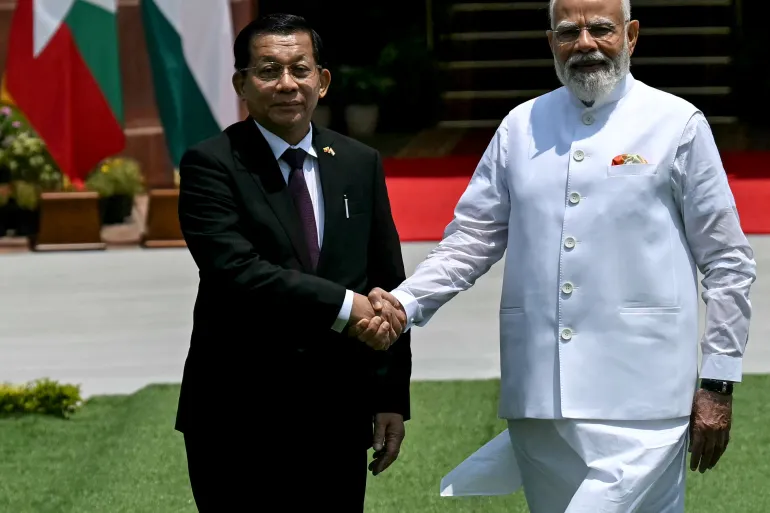
Indian PM Narendra Modi meets Myanmar leader Min Aung Hlaing in New Delhi, sparking debate over diplomacy, security, and regional ties.
Modi Meets Myanmar Leader Amid Diplomatic Debate Over Engagement
Indian Prime Minister Narendra Modi held talks with Myanmar’s military-backed leader Min Aung Hlaing in New Delhi, reaffirming India’s commitment to maintaining dialogue and cooperation with its neighboring country despite growing international criticism of Myanmar’s ruling administration.
The high-level meeting has attracted attention from political observers, human rights advocates, and opposition groups in Myanmar, many of whom argue that engaging with the military leadership could strengthen its legitimacy. However, Indian officials maintain that continued diplomatic engagement remains the most practical approach to promoting stability, security, and regional cooperation.
During discussions in New Delhi, both leaders focused on a wide range of issues, including trade, defense collaboration, border management, connectivity projects, energy cooperation, technology partnerships, and regional security challenges. Indian officials emphasized that their approach toward Myanmar is based on long-term strategic interests rather than commentary on the country’s internal political structure.
Myanmar has remained under military rule since the 2021 coup that removed the elected government and led to the detention of several civilian leaders, including former State Counsellor Aung San Suu Kyi. The political upheaval triggered widespread protests, armed resistance movements, and an ongoing conflict that continues to affect large parts of the country.
Since the coup, many Western governments have imposed sanctions and reduced engagement with Myanmar’s military leadership. India, however, has pursued a different strategy, arguing that maintaining communication channels is essential for addressing shared challenges and supporting regional stability.
Indian officials believe that isolation has historically produced limited results and that constructive engagement offers a better opportunity for cooperation on issues that directly affect both nations. This position reflects India’s broader foreign policy approach of maintaining dialogue with neighboring countries even during periods of political uncertainty.
The visit marks Min Aung Hlaing’s first trip to India since assuming the presidency earlier this year. Prior to arriving in New Delhi, he visited Bodh Gaya in the eastern Indian state of Bihar, one of the most significant pilgrimage destinations in Buddhism. The site holds immense religious importance as the place where the Buddha is believed to have attained enlightenment.
India and Myanmar share a long land border stretching more than 1,600 kilometers, making bilateral cooperation vital for managing cross-border security concerns. The two countries have worked together for years to combat insurgent activities, strengthen intelligence-sharing efforts, and address challenges related to illegal trafficking and organized crime.
Security cooperation was a major topic during the discussions between the two leaders. Officials highlighted ongoing efforts to tackle cybercrime networks and human trafficking operations that have affected citizens across the region. In recent years, thousands of individuals have reportedly been lured into fraudulent online operations operating in parts of Southeast Asia. Collaborative efforts between India and Myanmar have helped rescue numerous affected individuals and disrupt criminal networks.
Economic cooperation also featured prominently during the talks. Both sides expressed interest in expanding bilateral trade, increasing investment opportunities, and accelerating infrastructure projects that improve regional connectivity. Areas such as energy development, critical minerals, transportation, and digital technology were identified as potential sectors for deeper collaboration.
Myanmar’s strategic location makes it an important partner for India’s regional development initiatives and connectivity plans linking South Asia with Southeast Asia. Improved transportation networks and economic partnerships are expected to strengthen trade routes and support broader regional growth.
Despite the focus on cooperation, the visit has drawn criticism from Myanmar’s opposition movement and pro-democracy groups. Representatives of Myanmar’s shadow government and resistance organizations have urged India to consider the broader political implications of formally engaging with the military leadership.
Critics argue that such meetings risk normalizing military rule at a time when Myanmar continues to face political instability, armed conflict, and humanitarian challenges. They point to the ongoing struggles faced by civilians and the continued resistance against military governance throughout the country.
Supporters of India’s approach counter that engagement does not necessarily imply endorsement. Instead, they argue that maintaining diplomatic relations provides opportunities to address security concerns, facilitate humanitarian cooperation, and encourage dialogue during a period of uncertainty.
As regional dynamics continue to evolve, India’s relationship with Myanmar remains a significant component of its foreign policy strategy. The meeting between Modi and Min Aung Hlaing highlights the complex balance between diplomatic engagement, strategic interests, regional security, and concerns about democratic governance.
With both nations signaling a desire to deepen cooperation across multiple sectors, the outcome of these discussions could influence future economic, security, and political developments throughout South and Southeast Asia.