At least 25 people, including six police officers, were killed in gang-related attacks in Honduras as the government intensifies efforts to combat organized crime and violence.
Gang Violence Kills at Least 25 in Honduras Amid Growing Security Crisis
Honduras witnessed one of its deadliest days in recent years after a wave of gang-related violence killed at least 25 people, including six police officers, in separate attacks across the country. The shootings have intensified fears over public safety and raised serious concerns about the effectiveness of the government’s ongoing crackdown on organized crime.
The attacks occurred in different regions of Honduras and highlighted the country’s continuing struggle with gang violence, drug trafficking, land conflicts, and weak security institutions. Authorities have launched emergency operations in the affected areas as pressure grows on the government to restore order and protect civilians.
The deadliest incident took place in the northern municipality of Trujillo, where armed men stormed a palm plantation and killed at least 19 people. According to local reports, the victims included plantation workers and individuals believed to be connected to armed groups operating in the area.
Witnesses described scenes of panic and chaos as gunmen opened fire indiscriminately. Images from the attack site showed bodies scattered across the plantation grounds, many wearing work clothing and rubber boots commonly used by agricultural laborers. Reports indicated that the victims ranged in age, with some older workers also among the dead.
Authorities are still investigating the exact motive behind the massacre, but the region has long been linked to violent disputes involving land ownership, narcotrafficking, and illegal armed groups.
The area surrounding the Aguan River Valley has experienced decades of conflict between local communities, criminal organizations, and powerful agricultural interests. Armed groups are believed to control several African palm plantations, using profits from palm oil production and illegal activities to fund weapons and operations.
Police officials say criminal groups have occupied lands illegally and turned some plantations into strategic bases for organized crime. However, local farming communities accuse large business interests and private actors of supporting armed groups to seize disputed land and intimidate residents.
Land rights activists and environmental defenders have frequently been targeted in the region. Human rights organizations have repeatedly warned that violence linked to land disputes and agribusiness interests continues to threaten vulnerable communities.
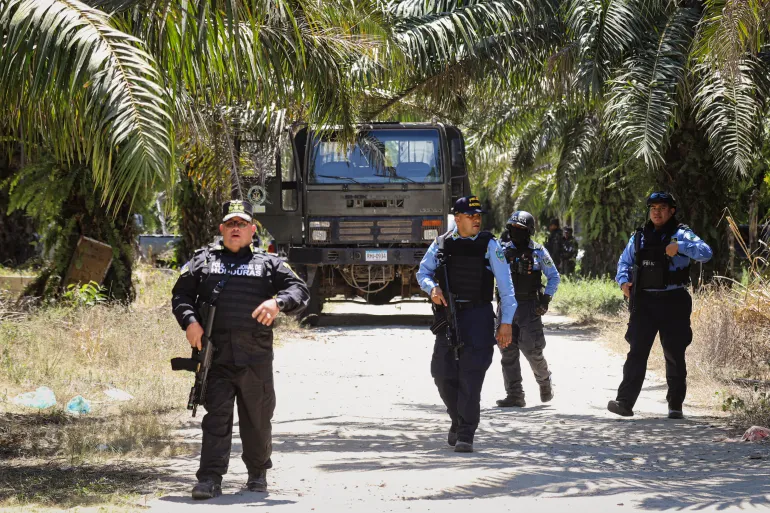
In another deadly incident on the same day, six police officers were killed in an ambush near the Guatemalan border in the municipality of Omoa. According to security officials, the officers had been deployed as part of an anti-gang operation when heavily armed attackers opened fire on their convoy.
The attack demonstrated the growing risks faced by law enforcement officers in Honduras, where gangs and criminal networks are often heavily armed and deeply entrenched. Security forces have struggled for years to dismantle criminal organizations involved in extortion, drug trafficking, smuggling, and territorial control.
Following the attacks, Honduras National Police announced immediate intervention measures in the affected regions. Authorities pledged to capture those responsible and strengthen security operations aimed at protecting vulnerable communities.
The violence comes at a politically sensitive time for Honduras. The government has recently intensified its anti-crime campaign, introducing tougher laws and expanding security powers in an attempt to combat gangs and organized crime.
Earlier this week, lawmakers approved legislation allowing authorities to officially classify gangs and drug cartels as terrorist organizations. The government has also established a specialized anti-organized crime unit to coordinate operations against criminal groups.
Until earlier this year, large parts of Honduras were under a state of emergency that granted security forces expanded powers to combat gang activity. The emergency measures were first introduced in 2022 as violence and extortion cases surged across the country.
However, the state of emergency ended after the inauguration of President Nasry “Tito” Asfura, whose administration has adopted a strong security-focused approach similar to broader regional anti-crime policies in Latin America.
Supporters argue that tougher security measures are necessary to regain control over areas dominated by gangs. Critics, however, warn that expanded powers could lead to abuses, weaken civil liberties, and increase militarization without addressing the root causes of violence such as poverty, corruption, and inequality.
Honduras remains one of the most dangerous countries in Central America despite recent declines in homicide rates compared to previous decades. Criminal gangs continue to exert influence in many neighborhoods and rural regions, often operating alongside drug trafficking networks connected to international organized crime.
The latest attacks have shocked the nation and renewed calls for stronger security policies, judicial reform, and protection for vulnerable communities. Many citizens fear that unless deeper structural issues are addressed, violence will continue to threaten stability and economic development across Honduras.
As investigations continue, authorities face mounting pressure to deliver justice for the victims and prevent further bloodshed in a country long scarred by gang violence and insecurity.