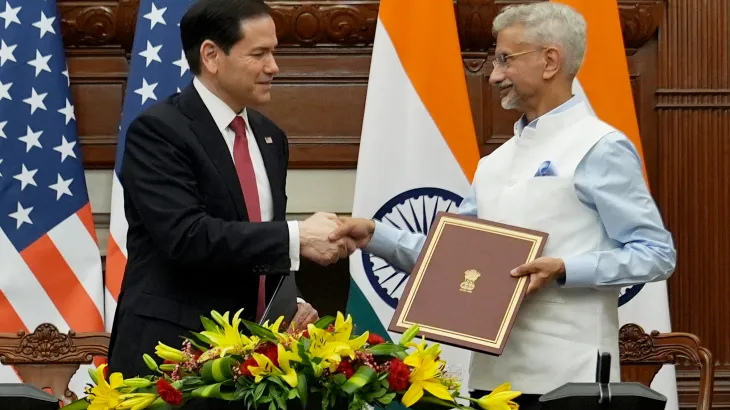
India and the US signed a critical minerals deal to reduce China reliance and strengthen rare earth supply chains globally.
India and US Sign Critical Minerals Deal to Strengthen Supply Chains
India and the United States have signed a major framework agreement focused on critical minerals and rare earth supply chains. The deal aims to strengthen cooperation in mining, processing, recycling, and investment in minerals that are essential for advanced technology, renewable energy, defense equipment, and semiconductor manufacturing.
The agreement was finalized during a meeting between Indian External Affairs Minister Subrahmanyam Jaishankar and US Secretary of State Marco Rubio in New Delhi. The announcement came alongside discussions among Quad member nations, including India, the United States, Japan, and Australia.
The framework reflects a growing global effort to reduce dependence on China, which currently dominates the global rare earth minerals market.
Why Critical Minerals Matter
Critical minerals are essential raw materials used in a wide range of industries. These include electric vehicles, batteries, semiconductors, smartphones, renewable energy systems, military hardware, and artificial intelligence technologies.
Some of the most important critical minerals include lithium, cobalt, nickel, copper, graphite, zinc, and rare earth elements. Rare earths are especially valuable because of their magnetic properties, making them necessary for electric motors, wind turbines, industrial robots, and defense systems.
Modern economies depend heavily on these minerals. As global demand for clean energy and advanced technology rises, countries are racing to secure reliable mineral supply chains.
The United States imports many of the critical minerals it uses. For several minerals, the country depends almost entirely on foreign suppliers. This has increased concerns in Washington about supply chain security and geopolitical risks.
China’s Dominance in Rare Earths
China remains the world’s largest player in the rare earth sector. It controls a major share of both mining and processing capacity. Although rare earth deposits exist in several countries, processing them is expensive and environmentally challenging.
China is estimated to process nearly 90 percent of the world’s rare earth supply. This has given Beijing significant influence over global supply chains. As tensions between China and Western countries continue, nations like the US, India, Japan, and Australia are looking for alternative sources.
The India-US agreement is part of a wider strategy to diversify global mineral supplies and reduce vulnerability to single-country dominance.
What the India-US Framework Includes
The new framework focuses on cooperation across the entire critical minerals value chain. This includes:
- Exploration and mining
- Processing and refining
- Recycling technologies
- Infrastructure development
- Supply chain security
- Investment partnerships
The agreement also highlights cooperation in protecting supply chains from market manipulation and geopolitical disruptions.
Although detailed financial or operational terms have not been publicly released, both governments described the framework as a long-term strategic partnership.
India also joined a US-led initiative earlier this year aimed at strengthening secure semiconductor and AI-related supply chains.
India’s Growing Rare Earth Potential
India possesses significant reserves of critical minerals and rare earth elements. In recent years, the Indian government has increased efforts to identify and develop domestic mineral resources.
The country has officially identified 30 minerals as strategically important. These include lithium, cobalt, graphite, nickel, silicon, titanium, copper, and rare earth elements.
One of India’s major mineral resources is monazite, a mineral rich in rare earth oxides. Government estimates suggest India has millions of tonnes of rare earth oxide reserves, although much of this potential remains underdeveloped due to limited infrastructure and technology.
Currently, India produces only a small number of critical minerals at large scale. Challenges such as limited exploration, processing facilities, and investment have slowed growth in the sector.
To address this, India’s latest national budget introduced plans for “rare earth corridors” in states including Odisha, Kerala, Andhra Pradesh, and Tamil Nadu. These hubs are expected to support mining, processing, research, and manufacturing of high-performance rare earth magnets.
These magnets are crucial for electric vehicles, renewable energy systems, and advanced electronics manufacturing.
Quad Nations Launch $20 Billion Initiative
Alongside the India-US agreement, Quad countries also announced a broader critical minerals initiative. The four nations plan to mobilize up to $20 billion through loans, guarantees, subsidies, and private investment.
The initiative will support projects related to mining, refining, recycling, and technology development. It also aims to improve coordination among partner countries on regulations, licensing, and environmental standards.
Recycling critical minerals has become another important priority. Recovering minerals from used batteries and electronic waste could help reduce pressure on mining operations while strengthening long-term supply security.
Global Competition for Critical Minerals Intensifies
The United States has recently signed similar mineral agreements with several countries, including Argentina, Peru, Morocco, South Africa, Pakistan, and the United Kingdom.
These partnerships show how critical minerals are becoming central to global economic and geopolitical competition. Access to rare earths and battery minerals is now considered essential for energy transition goals, defense manufacturing, and technological leadership.
For India, the agreement with the US could bring investment, advanced technology, and stronger integration into global supply chains. For Washington, it offers an opportunity to reduce dependence on China and build more resilient partnerships in Asia.
As the global demand for electric vehicles, AI systems, and renewable energy infrastructure continues to grow, critical minerals are expected to become one of the world’s most valuable strategic resources.